Juniper Bevensee · 27/05/2026
Multi-player AI is here
This piece now lives at Cyborg Garden. NimbleCo keeps it here as history.
Introducing Swarm Map
Swarm Map was called Hermes Swarm Map when this post went out in May 2026. Same project, shorter name. It now lives at cyborg-garden/swarm-map.
Status note, August 2026: this page is kept as history and is not updated. The memory-scoping work described below shipped in Swarm Map and in the hermes-agent-mt fork. Whether it landed in NousResearch/hermes-agent itself is a question for the linked upstream issue, not for this post.
A point and click GUI for a fleet of Hermes agents: which agent runs in which chat, who is allowed to invoke it, what it remembers, and what it costs. It solves the multi-tenant Hermes problem. Every agent, every context and every bill on one screen. Share compute.
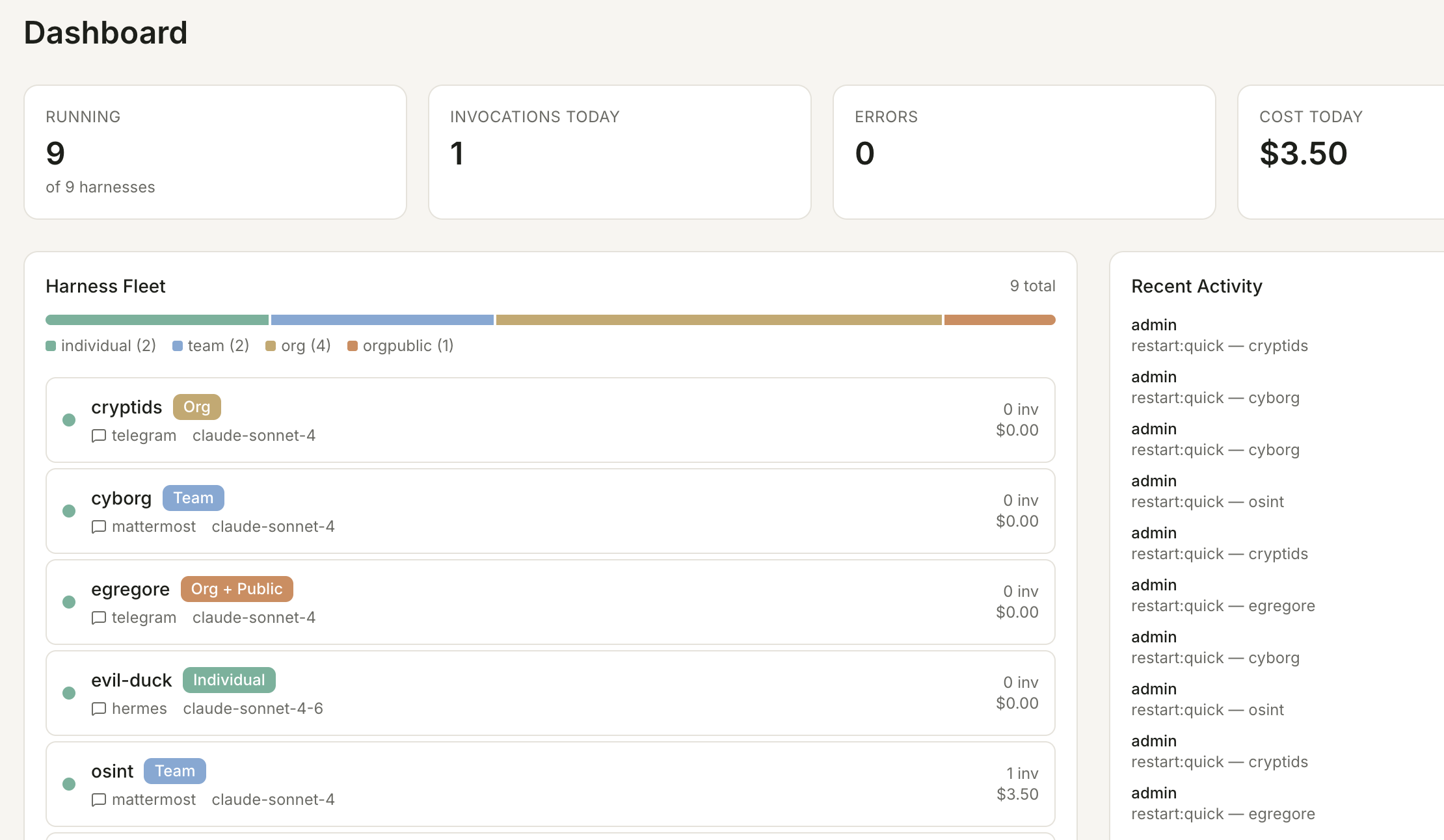
Calm operator panel for multiple Hermes agents in different contexts.
Imagine your personal AI agent breaking down a long voice memo on Signal, cross-referencing it with gaps in your email, and suggesting a follow-up you'd forgotten about. It grows with you, learning your patterns, automating your friction, connecting the dots across different sources and surfaces.
Now imagine that same agent deployed to your team's Discord. A journalist's research collective on Signal. A community project's Telegram group. A venture's entire operational stack, covering content, research and coordination. Each agent learns and acts within its own context, and none of them leak what they learn into the wrong conversation.
This is multiplayer agentic AI: agents that live in human communities, learn per context, and never carry what they learned in one room into another.
We've been running multiplayer agentic experiments for a year with real users on the platforms people already use (Signal, Discord, Telegram, Matrix, etc).
Now, we’ve built a dashboard for running a fleet of scheduled agents across the chat platforms your people already use.
We released it publicly under AGPL v3, as part of the NimbleCo AI commons.
We solved the multi-tenant problem
Every AI agent framework hits the same wall the moment you deploy beyond personal use: one agent, one context. No isolation. Run a Hermes agent in a private DM and a public group chat simultaneously, and sensitive information from the DM gets injected into the group session, where anyone can prompt the agent to reveal it.
This isn't hypothetical. In the Hermes community alone, there are 12+ open issues that are all symptoms of this root problem. It can be dubbed the "Hermes multi-tenant problem". The quotes from real operators are blunt:
"This is the single reason I haven't migrated to Hermes yet." — An operator running 9 specialized agents on a competing framework
"Content agent read competitor monitoring memory and wrote it into a public article. Boss almost made me face a lawsuit." — A production incident report
The workarounds are all variations of "run N separate processes", which doesn't scale, wastes resources, and defeats the purpose of a unified agent platform. We looked at how every major framework handles this: LangChain's namespace tuples, OpenAI's thread isolation, AWS Bedrock's tenant primitives. None of them are open-source, self-hosted, and actually running in multiplayer production.
So we built it.
Collective Alignment
The technical problem is memory isolation. But the real stakes are much higher.
Every group chat, every Signal thread, every Slack channel is a context where humans and agents build shared understanding. When an agent learns something in one context and leaks it to another, the failure is not privacy. It is alignment: the agent's behavior no longer reflects the intent of the people it's working with.
Multiplayer, grassroots agentic AI, done right, enables something centralised frontier labs can't: pluralistic alignment. Instead of one monolithic model and harness refined on everyone's data and aligned to one company's values, you get networks of agents, each sovereign to their community, each learning from their specific context, each accountable to the people who deployed them. All with parts that you can modify or repair on demand.
This is what we mean when we say we grow minds, not tools.
Not that AI is "sentient" in the human sense, but that we are creating a novel form of collective intelligence together.
What We Built
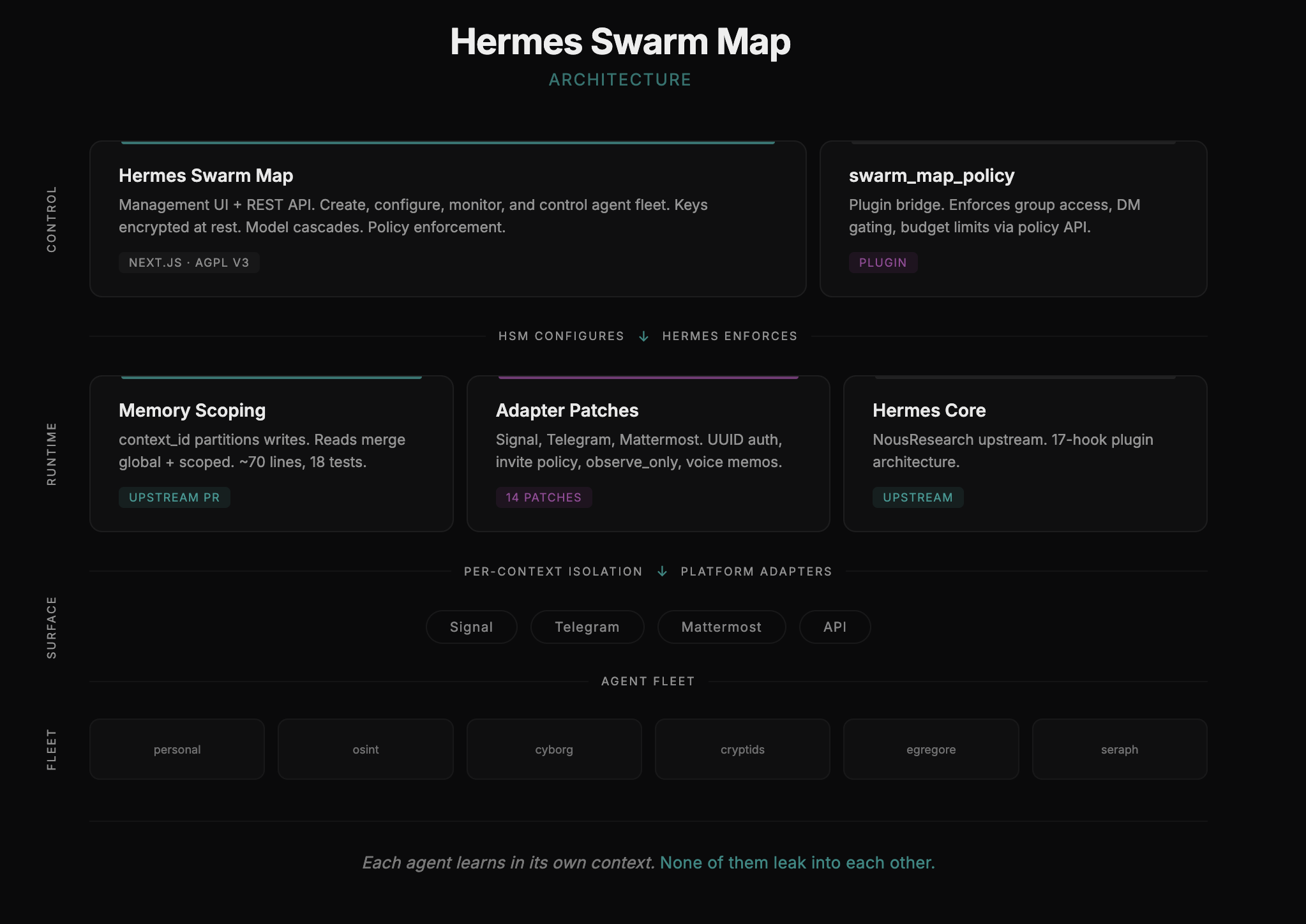
Swarm Map architecture.
Three layers, shipping together:
Memory Scoping (Upstream Contribution)
The core fix: a context_id parameter on Hermes's memory layer that partitions writes into per-context subdirectories. Reads merge global and scoped memories, so the agent's core knowledge (name, personality, skills) is available everywhere, but what it learns in Group A stays in Group A.
~70 lines across 4 files. 23 test cases. Fully backwards-compatible: existing single-tenant deployments see no changes. Isolation is enforced by tests, not assumed: path separators in a context_id are sanitized before they reach the filesystem, and a scoped context can't replace or remove a global entry.
We took this upstream to NousResearch/hermes-agent as a PR, along with a proposed memory:scope hook that lets any plugin define its own isolation policy without forking core.
The Thin Fork (hermes-agent-mt)
Memory scoping is the foundation, but running agents across platforms requires more. Our fork carries 35 commits (~28 net unique functional changes): 4 core, 11 adapter-level, 4 plugins, 3 security/fix, 5 infrastructure, and 3 documentation, covering Signal UUID authentication, group invite handling, SSE reconnect, voice memo detection, mention gating, and more.
The philosophy: stay as close to upstream as possible. An automated CI/CD workflow syncs against upstream weekly. We recently rebased onto 410 upstream commits with only 3 conflicts. When upstream accepts our memory scoping PR, the fork shrinks to pure adapter patches, the kind of thing that's too platform-specific for upstream but essential for production deployment.
Swarm Map
This is the control plane. A Next.js management UI that discovers, configures, and controls your entire agent fleet.
For users: Your agents just work. They remember your conversations, connect your data, grow with your context. You interact on Telegram, Signal, Mattermost, or API. The platform doesn't matter. Use plain human language for complex operations and generate scripts to verify, in the chat platforms you already use.
For operators: A GUI dashboard for your entire fleet. Create agents through a 5-step wizard that deploys secure-by-default containers. Manage API keys (AES-256-GCM encrypted at rest), model fallback cascades across providers, per-surface access control, memory scopes, tool registries, and policy enforcement, all from a browser.
For builders: Every action in the GUI is backed by a REST API. If you can vibe-code, you can orchestrate your fleet programmatically: deploy new agents, hot-swap model cascades, read logs, manage keys, add new tools etc. Claude Code, Hermes itself, or a simple curl command can be your admin.
git clone https://github.com/cyborg-garden/swarm-map.git
cd swarm-map
pnpm install && pnpm run seed && pnpm run dev
That's it. Point it at your existing Hermes agents and they appear in the dashboard instantly, whether Docker or bare-metal, compose or standalone. Want full multi-tenant? The import wizard copies your agent's data to a new managed directory, patches in the Swarm Map plugins, and optionally upgrades to the MT fork image. Your original stays untouched as a backup. Or use the wizard to deploy fresh agents with secure-by-default configuration. Either way, you're managing your swarm.
Who This Is For
A friend group sharing a research assistant that keeps each conversation private. A journalist collective running OSINT agents across encrypted channels. A scrappy venture with agents handling content, research, and operations, each in their own lane. An enterprise deploying 50 agents across departments with strict data boundaries. Someone job hunting who would rather send a voice memo than write a cover letter, with an agent that answers on the app already on their phone.
Swarm Map scales from one agent on a laptop to a fleet on a server. The same AGPL-licensed codebase. The same security model. No cloud dependency. No vendor lock-in. Local-friendly by default, but frontier models supported widely.
What's Next
This was v1, and it was experimental software when it shipped.
The architecture is designed for what comes next: hard budget enforcement per agent, capability gating (controlling what each agent can do and who can trigger it), context-scoped skills, greater people awareness, advanced analytics etc. The roadmap is public in the repo. People who land real work on it get early access to what is coming next, and we say who did it.
But the most important next step is upstream. We want these memory scoping changes in NousResearch/hermes-agent as a first-class feature, not as a fork.
Multiplayer is too important to fragment the ecosystem over. Please support and discuss our open issue and PRs on main.
Get Involved
Swarm Map, the management UI (AGPL v3)
hermes-agent-mt, the multi-tenant fork (MIT)
NimbleCoAI, the network behind the work
We're a small team that's been running this in production, hitting the real failure modes, and building the fixes.
Come squint at the horizon of strangeness with us.